Blog
Japanese VS Korean Beauty Standards– Beautiful With Brains


Last Updated on April 13, 2026 by Giorgia Guazzarotti
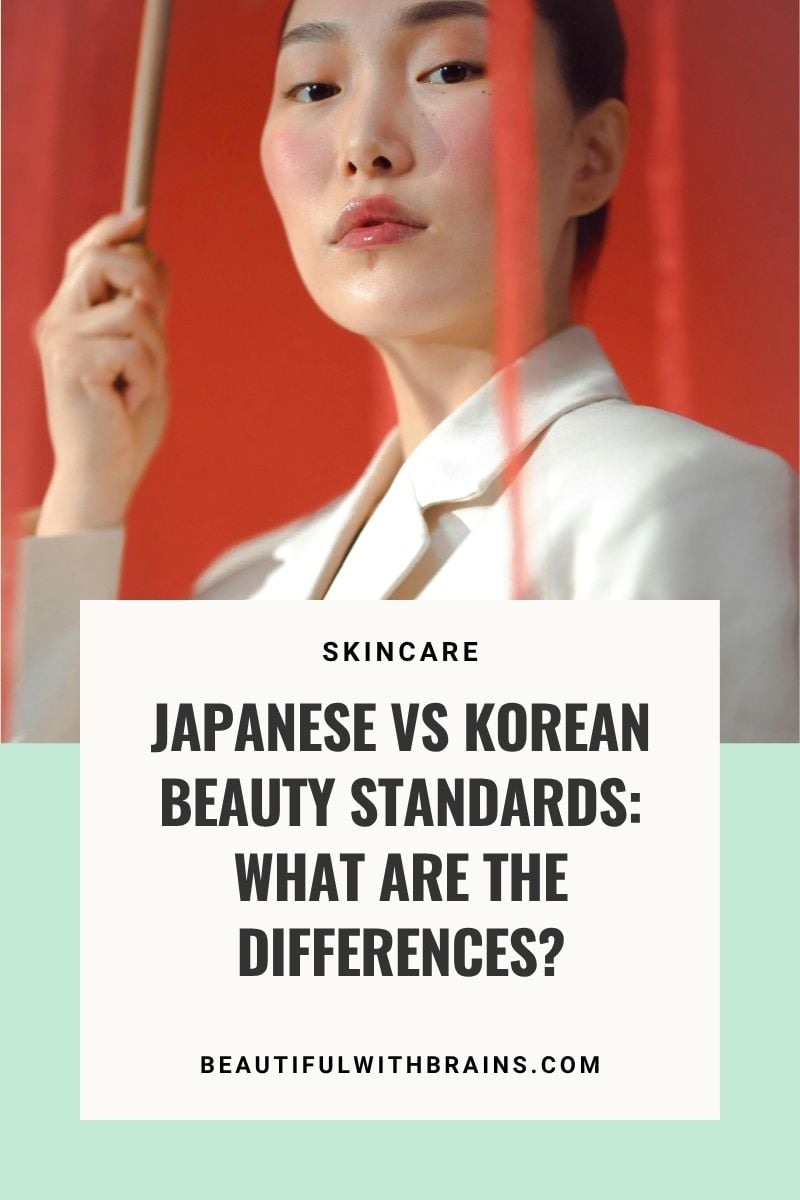
Ever wondered what’s the difference between Japanese vs Korean beauty standards? In the West, they’re often lumped together. But, just because they come from Asia, doesn’t mea they have the same approach to beauty. It’s true both countries are obsessed with healthy skin. Both have beauty industries that have had a huge impact globally. Both have exported ingredients and rituals that people in the United States and beyond have adopted into their own routines. But once you actually dig in, you realise the K-beauty approach is quite different from the Japanese one. This article breaks down exactly what separates J-Beauty from K-Beauty across skincare, ingredients, regulatory frameworks, and makeup, so you can stop guessing and start making choices that actually make sense for your skin.
The Skin Ideal: Two Very Different Definitions of Beautiful
Japanese beauty standards are built around something called mochi skin – named after the soft, pillowy Japanese rice cake, which is genuinely one of the more accurate food comparisons in the world of beauty. Mochi skin is smooth, even, plump, and has a kind of soft matte-satin finish to it. It doesn’t glow aggressively or look wet. It just looks like skin that has been quietly and consistently looked after for years. The deeper idea behind it is rooted in a concept called bihaku – loosely translated as “beautiful white” – which isn’t about skin tone in a narrow sense but about achieving a luminous, sun-protected complexion that looks naturally radiant.
Korean beauty standards are after something else entirely: glass skin. The korean ideal – sometimes called “chok chok” – is skin that looks so hydrated and smooth it’s almost translucent, with a dewy, lit-from-within glow. Think less rice cake, more freshly watered plant. Achieving it means layering hydration, running a multi-step routine, and using korean skincare products specifically designed to create that visible luminosity. This ideal is deeply tied to K-pop and Korean dramas, where skin is genuinely part of the performance – and it’s driven an entire industry of innovation around getting there.
The Routines For Perfect Skin: Less VS More
A typical Japanese skincare routine is deliberately minimalist. Oil cleanser, gentle water-based cleanser, a hydrating toner or lotion, maybe a serum or essence, moisturiser, and sunscreen. That’s the core of it. Japanese brands aren’t trying to sell you a ten-step system – the Japanese philosophy is about doing a small number of things really well, with formulas that have been quietly researched and refined over decades, low fragrance, and a don’t-irritate-the-skin-barrier approach that runs through almost everything.
The Korean routine – at least the version that took the world by storm – is the opposite of that. The famous multi-step routine goes: oil cleanser, water cleanser, exfoliator, toner, essence, serum or ampoule, sheet masks, eye cream, moisturiser, SPF. Each step has its logic. The idea is that layering lightweight hydrating products builds a depth of moisture that a single heavy cream can’t replicate – kind of like compound interest for your skin. Small deposits, consistently applied, that accumulate over time into something genuinely impressive.
Here’s where it gets a bit uncomfortable for anyone who’s committed to the maximalist approach though. A Korean dermatology clinic study found that higher cosmetic product use correlates with more cases of allergic and irritant contact dermatitis – the researchers specifically flagged that using a lot of products increases the chance of sensitisation reactions developing. And dermatologists in South Korea have been seeing more barrier dysfunction in recent years – reactive, over-exfoliated skin that stings at everything. The 10-step routine as it was sold to a global audience was never really designed with compromised or sensitive skin in mind, and honestly, the Korean beauty industry has been quietly correcting course, shifting toward simpler barrier-first approaches that look a lot more like what Japan was doing all along.
Worth noting: an expert panel of Asian dermatologists using formal consensus methodology concluded that the actual foundation of effective skin care is cleansing, moisturisation, and photoprotection – full stop. Everything else is supplementary. Japan built its whole industry on those three things. Korea built its brand on everything beyond them.
Related: 4 Things I Learned From Korean Skincare
The Ingredients: Proven VS. Promising
This is where the difference gets genuinely meaningful from a science standpoint, so it’s worth slowing down here. Japanese skincare products lean on ingredients that have been tested within a regulatory system that has no real equivalent anywhere else. Japan has a category called “quasi-drugs” – products that sit between cosmetics and pharmaceuticals. To earn that classification, a product has to demonstrate mild medicinal effects through clinical testing before it’s approved for the market. That’s a real bar, especially compared to most countries where brands only have to prove their products are safe, not that they actually do what they claim.
Ingredients that have passed through this system include arbutin, with demonstrated efficacy against hyperpigmentation at approved concentrations; kojic acid, which inhibits the tyrosinase enzyme that drives melanin production and has clinical trial data backing it up; and tranexamic acid, originally developed in Japan for medical use and proven effective for treating pigmentation disorders. Rice bran extract and vitamin c derivatives have also been extensively studied for brightening and antioxidant effects within japanese regulatory frameworks. When a Japanese brand makes a claim about dark spots or youthful appearance, there’s often actual peer-reviewed data somewhere behind it.
Korean cosmetics work differently. K-Beauty is extraordinary at identifying new ingredients and getting them to market fast – sometimes so fast that the clinical literature hasn’t had time to catch up. Snail mucin, centella asiatica, fermented extracts, bee venom, red ginseng, aloe vera compounds, starfish powder – this is a world of skincare that is endlessly creative and genuinely innovative and, frankly, fun to explore. A 2020 review published in the Journal of Cosmetic Dermatology confirmed that K-Beauty bioactives are increasingly being studied, but concluded that further research is needed to fully establish biological mechanisms before they translate into clinical practice.
That’s the honest summary of where things stand. Centella asiatica has real anti-inflammatory data behind it and is a legitimate active ingredient for calming irritation and supporting skin healing. Snail mucin contains glycoproteins, hyaluronic acid, and glycolic acid – substances that make scientific sense as skin-supporting ingredients, even if large-scale clinical trials haven’t caught up to the anecdotal enthusiasm around them. The issue isn’t that K-Beauty ingredients don’t work – some of them clearly do. The issue is that the marketing has historically run a few years ahead of the proof.
Both countries share a deep commitment to hyaluronic acid, ceramides, and fatty acids as barrier-supporting hydrators – because the evidence base for all of these is extensive and solid, and healthy skin that retains moisture is the prerequisite for everything else.
Sunscreen: Japan Quietly Wins This One
If there’s one area where the Japanese approach has a genuinely superior track record, it’s sun protection – and this matters enormously because photoprotection is the single most evidence-backed anti-ageing intervention in dermatology, full stop. Japanese sunscreens are formulated to some of the most rigorous cosmetic standards in the world. They’re lightweight, they don’t leave white cast, they’re comfortable to wear daily, and they work. The PA++++ rating system used in Japan specifically measures UVA protection (that’s the ageing radiation, not just the burning kind) and Japanese companies have invested heavily in developing filters that protect across a broad spectrum without feeling like a chore to apply.
Korean sunscreens have gotten genuinely excellent in recent years too, but Japan’s heritage in this space is longer and the investment runs deeper. Sun protection is treated as the cornerstone of the Japanese skincare routine in a way that K-Beauty’s product culture – which tends to get more excited about new serums and essences – doesn’t quite replicate.
Related: What Are The Best Japanese Sunscreens?
The Makeup: Two Different Versions of Pretty
The makeup aesthetics are where the philosophical divide becomes most visually obvious, and they mirror the same logic as the skincare. Japanese makeup is soft, kawaii-leaning, and deliberately sweet-looking. The goal is approachability, not drama. A typical look uses lightweight base coverage – often a tone-up cream or powder rather than full-coverage foundation – to even out the skin without masking natural features. Eye makeup is drawn downward in the puppy eye technique, creating rounder, more innocent-looking eyes. Blush is placed high, often directly under the eyes in the “hangover” or Igari style, giving the face a naturally flushed, youthful quality. Brows are soft and natural-looking. Lips are glossy or lightly tinted rather than bold. The overall finish is matte or satiny – in line with the mochi skin ideal underneath.
Korean makeup moves differently. The glass skin base is everything, and dewy BB creams and cushion foundations are used to build that luminous, hydrated canvas. Eye makeup is more defined, with liner used to elongate and dramatise. Straight, slightly thick brows are a deliberate stylistic signature – very modern, very K-pop. The gradient lip technique, where colour pools in the centre and fades at the edges, is one of K-Beauty’s most copied exports. The overall look is polished and trend-conscious in a way that japanese cosmetics generally aren’t going for.
One detail worth mentioning: there’s actually some debate even among practitioners about the matte vs. dewy divide. Korean foundations tend to be more matte while Japanese technique aims for a subtle glow at the cheekbones – which just goes to show how fluid and evolving both aesthetics are. Nothing about either system is fully fixed.
The Bottom Line
Here’s the honest answer: neither system is universally better. They’re built for different needs. If you want clinical evidence, low irritation risk, long-term skin health, and sunscreen you’ll actually enjoy wearing, the Japanese beauty philosophy is the more scientifically grounded choice. Japanese brands have done the work within a framework that demands it, and their minimalist approach lines up with what dermatologists consistently recommend.
If you want ingredient innovation, deep hydration layering, and a customisable routine you can adapt to target specific concerns, K-Beauty has an extraordinary toolkit – just bring some healthy scepticism to it. Patch test new ingredients, don’t add multiple products at once, and pay more attention to how your skin actually responds than to whatever’s trending.
And the smartest approach honestly? Learn both well enough to borrow from each. Japan’s sunscreens are unmatched. Korea’s centella asiatica and ceramide-rich barrier repair products are outstanding. Green tea shows up in both traditions for good reason. Hyaluronic acid doesn’t care about cultural allegiance – it just works. Your skin doesn’t either. It cares about the right ingredients, applied consistently, with enough patience to let them do their job. That’s the part that neither culture has marketed very loudly, but both of them have always known.